

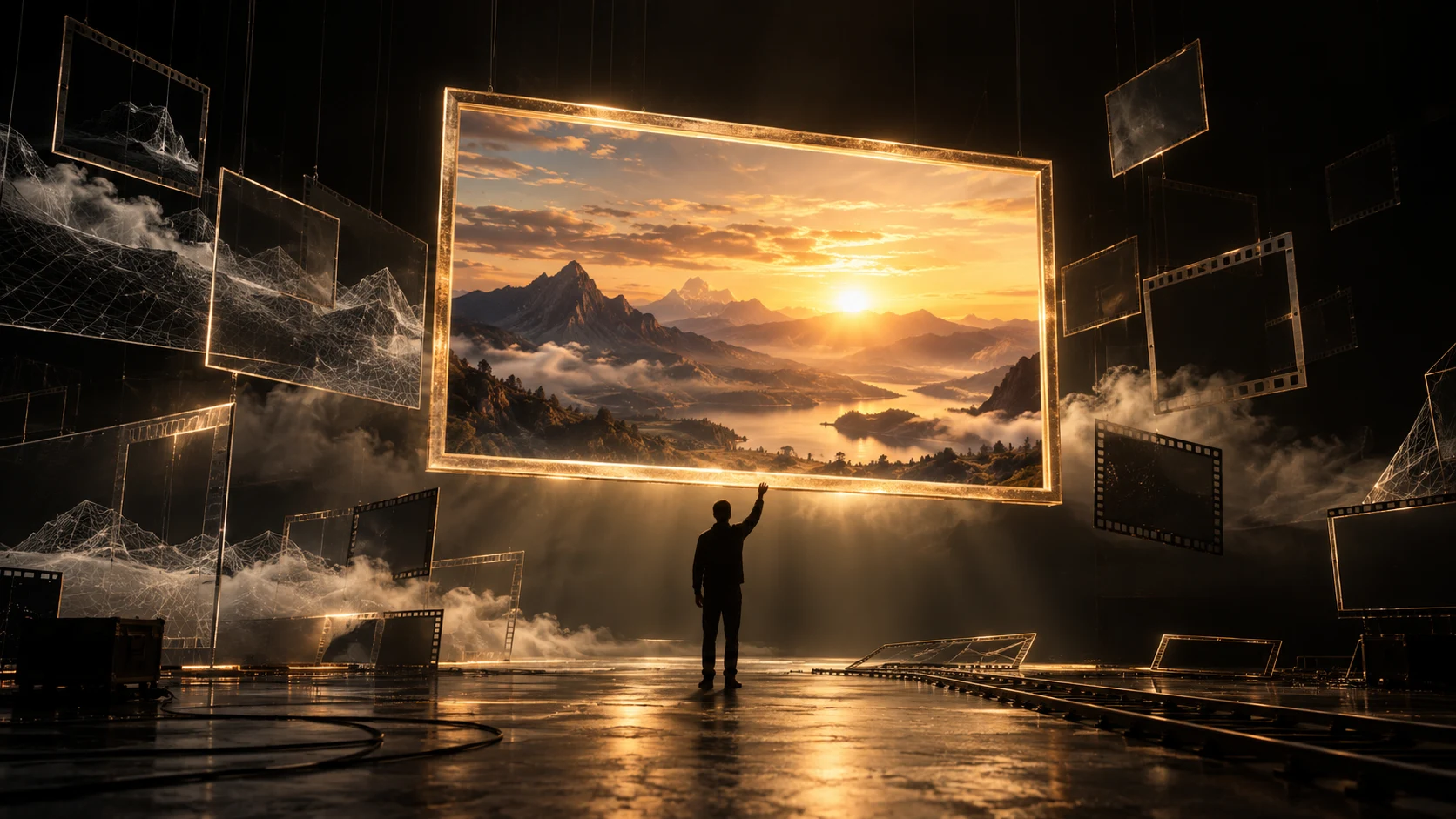
AI Can Generate the Frame. But Who Gives It Meaning?
The future of filmmaking isn't just artificial intelligence. It's human imagination, powered by AI.
Imagine creating a cinematic sequence that once demanded a substantial production budget, elaborate sets, a large crew, and weeks of preparation. Now imagine exploring that same creative vision using artificial intelligence, digital filmmaking, and a carefully designed production workflow.
Technology is changing what is possible. But when anyone can generate beautiful visuals, what makes someone a filmmaker?
The answer isn't the software they use. It's the vision behind what they create.
From technical limitations to creative possibilities
For years, filmmaking has been shaped by budgets, locations, equipment, lighting, time and talent. Every production decision operated within those boundaries. Today, AI-powered filmmaking is expanding the possibilities. Difficult ideas can be explored through generative AI, cinematography, CGI, animation and traditional post-production.
Increasingly, the question is not simply “Can we shoot this?” It is “How do we bring this vision to life?”
The biggest misunderstanding about AI filmmaking
A beautiful AI-generated video is not automatically a great film. A striking shot can attract attention, but storytelling demands emotion, continuity, character, composition, pacing, sound and meaning.
After 15 years working across multimedia production, video editing, cinematography, graphic design, motion graphics, animation and 3D visualization, I keep returning to one principle: technology changes how we create, but it does not eliminate the need to know why we create.
Direction matters more than generation
Tools for reference-guided creation, visual consistency and camera control are improving. The professional challenge, however, is not generating a single impressive shot. It is directing a complete visual experience.
A dramatic scene might use slow camera movement, restrained lighting, silence, an actor's expression and a precisely timed cut. Every choice supports the emotion. The same intentionality must guide AI-assisted storytelling.
Cinematic quality is not simply how realistic something looks. It is how effectively a visual communicates an idea.
Hybrid filmmaking is an opportunity
The future need not belong exclusively to traditional or fully AI-generated production. Hybrid filmmaking can bring together real cinematography, human performance, AI-assisted environments, CGI, 3D animation, motion graphics, editing, color grading and sound design.
The camera still matters. Performance still matters. Editing still matters. Above all, creative direction matters. The advantage lies in understanding when each technique genuinely serves the story.
Consistency, quality and trust
Production-ready AI storytelling presents real challenges: preserving character identity, natural expressions and physical motion; maintaining continuity between shots; and matching lighting, color and atmosphere. Brands and filmmakers also need clear permissions, responsible representation and appropriate transparency when AI is involved.
Content provenance initiatives such as C2PA help the industry communicate the origin and editing history of digital media. Trust should be considered throughout production, not added as an afterthought.
What defines the next generation?
Strong creative professionals will combine production knowledge with emerging AI tools. Not merely writing prompts, but directing scenes, building narratives, managing continuity, solving visual problems and finishing work that serves a purpose.
For brands, the most important questions are not “Was this made with AI?” but “Does the story connect?” and “Does the visual communicate something valuable?”
Imagination must lead. Technology must follow.
As a Creative Head, AI Content Creator and filmmaker, I see artificial intelligence as a way to explore ideas that once seemed impractical. But I do not see it as a substitute for creative thinking. It is another powerful tool in the filmmaker's kit.
Models will become faster and more capable. The intention behind the work must remain clear. The future of filmmaking will not be defined by who can generate the most content, but by who can turn extraordinary technology into extraordinary storytelling.
AI can generate the frame. But imagination gives it meaning.
JEFF LAW
Creative Head · AI Filmmaker · AI Content Creator · Director
BEYOND IMAGINATION. BEYOND REALITY.
Industry references
JEFF LAW / Discussion
What gives a frame meaning?
Loading discussion…
Like or share directly. Add your name and comment below. Comments appear after approval.
Manage comments →Share the idea.
Bring someone into the conversation.